




Collaborative Testing Supports Contact Center Modernization
In Brief
Preparing a Large Utility’s Contact Center for Real-World Use
A major U.S. electric utility serving over 600,000 customers upgraded its customer contact center using the NICE CXone platform, with implementation partner Skybox leading configuration and deployment. The new environment supports hundreds of customer interactions across multiple departments. As a result, the team needed to confirm the system would work reliably under real operating conditions.
Resource Data led the testing efforts by developing a master test plan, creating more than 2,000 test cases, and coordinating testing across departments using real customer scenarios. Working together, the teams validated call flows, resolved defects, and prepared the system for go-live while helping the organization deliver dependable service to over half a million customers who rely on it every day.
Key Takeaways
A System Built for Many Customer Paths
-
Collaboration supported effective testing
Coordination between the utility, Skybox, and Resource Data allowed testing to run alongside system configuration so issues could be identified and resolved earlier.
-
Structured testing brought order to a complex rollout
A defined testing framework gave teams a clear way to validate call flows, Interactive Voice Response (IVR) routing, and customer-agent interactions before launch.
-
Cross-department participation validated real service scenarios
Internal testers from several operational departments including subject matter experts participated in testing to confirm the platform reflected day-to-day customer service workflows.
-
Testing prepared internal teams for live operations
Employees who participated in testing built hands-on knowledge of the platform and were able to support colleagues as “super users” during the rollout.
-
Testing assets support future platform updates
The scripts, documentation, and testing process created during the project now provide a repeatable way to validate future system changes.

The Challenge
Managing Risk in a Complex Contact Center Rollout
The utility was implementing a cloud-based contact center to improve how customers connect with service teams. The platform supports billing inquiries, service requests, outage reporting, and technical support. Serving more than 600,000 customers, the organization’s contact center spans multiple departments and relies on accurate routing, customer data access, and integrations with multiple systems.
The new environment included extensive IVR routing logic, more than 70 pages of call flow diagrams, and over a dozen system integrations. Testing these interactions required coordination across several operational teams, including outage management, integrations, and customer support. Without a structured testing process, validating these scenarios before launch would not have been possible. The project team needed a clear way to test how the system would perform under real operating conditions.
Our Approach
Turning Collaboration into Confidence
The contact center implementation required coordination between the utility’s internal teams, implementation partner Skybox, and Resource Data. Each group played a different role in preparing the system for launch. Skybox configured and deployed the NICE CXone platform, while internal teams provided operational insight into customer service workflows, outage management, and support processes. Resource Data completed detailed business analysis and testing including unit, functional, and UAT to validate all workflows within the system.
Regular working sessions allowed configuration, testing, and defect resolution to progress in parallel. Subject matter experts from several departments participated in testing to confirm that call flows, routing logic, and integrations reflected real operational scenarios. This collaborative model helped ensure the system worked not only from a technical standpoint but also within the organization’s day-to-day customer service operations.
We weren’t operating on the sidelines. Together with the client and Skybox, we formed a core team that worked through the testing and configuration issues.
- Andi Good, Sr. Project Manager, Resource Data
The Solution
A Testing Process Built for Reliability
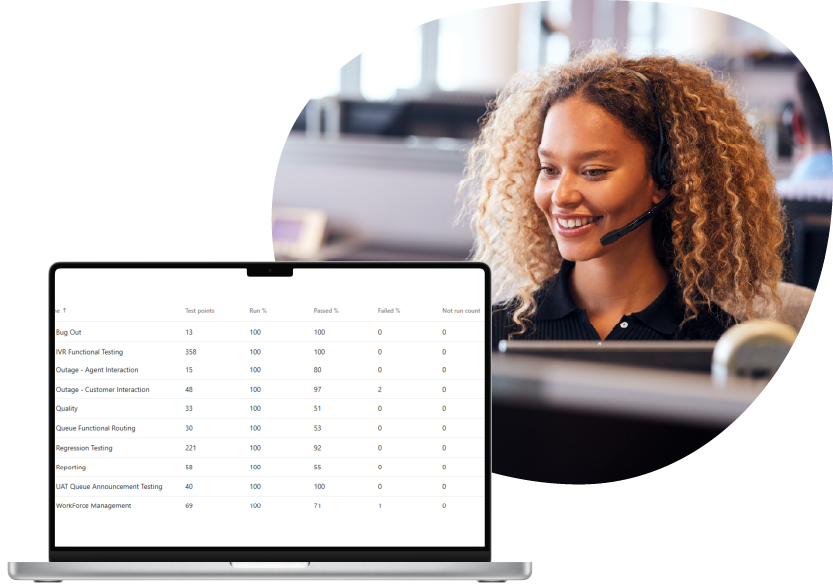
Resource Data designed and executed the testing framework used to validate the new contact center platform. The team developed a master test plan and created more than 2,000 test cases covering functional validation, user acceptance testing, and regression scenarios. These scripts tested customer and agent interactions across call flows, IVR routing, and system integrations.
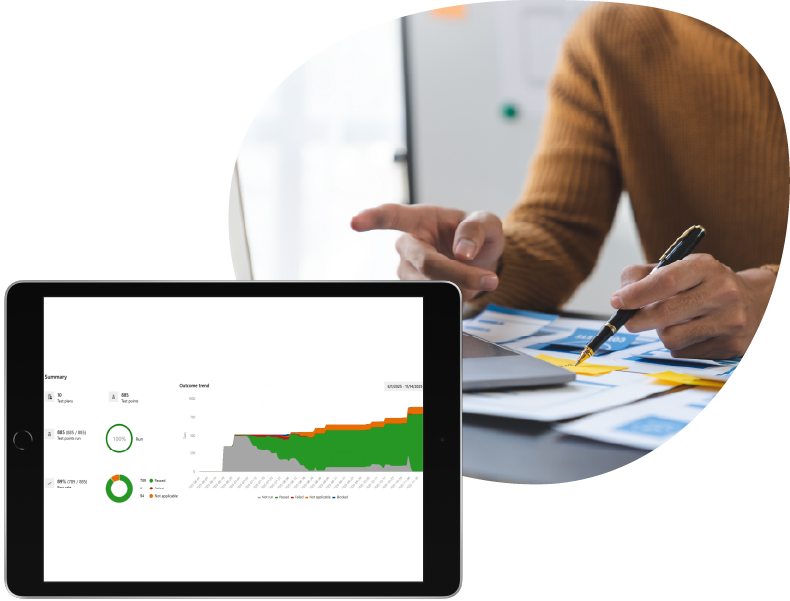
UAT testing involved 12 subject matter experts from multiple operational departments, who executed scripts based on real service scenarios. Test results and defects were tracked in Azure DevOps, giving the project team a shared system to log issues, coordinate fixes with the implementation partner, and confirm resolutions through retesting. Resource Data also supported internal testers with guidance on executing scripts, estimating testing time, and documenting issues consistently, helping the organization validate the system before launch.
Features
Sustainable Testing Assets and Documentation
-
Test planning structure for organized testing cycles
A master test plan and Azure DevOps structure organized testing cycles, documented results, and created a consistent process for tracking and resolving issues.
-
More than 2,000 test cases for comprehensive system validation
Detailed scripts supported unit, functional testing, user acceptance, and regression testing scenarios across customer and agent interactions.
-
Cross-team testing for real operational workflows
Subject matter expert testers from five operational departments participated in testing to validate real service scenarios and system integrations.
-
Defect tracking and retesting for reliable issue resolution
A structured workflow allowed teams to log, prioritize, resolve, and retest issues as system configuration progressed.
-
Testing guidance for effective internal participation
Resource Data provided instructions and training to help internal teams execute test scripts consistently and document issues clearly.
-
Reusable regression test assets for future system updates
The test library created during the project will be reused to validate system updates, new call flows, and additional features as the contact center platform evolves.


- Jennifer Lober, Sr. Business Analyst, Resource DataWe worked closely with the client and Skybox every day, reviewing results, resolving defects, and retesting. That level of coordination made a huge difference in delivering a successful launch.

Results
A Stronger Start for Customer Service
The structured testing effort helped the utility launch its new contact center with operational confidence. By validating real service scenarios before deployment, the team reduced the risk of disruptions to critical customer interactions such as billing support, service requests, and outage reporting. Testing also prepared internal teams for the transition. Employees who participated in testing developed hands-on knowledge of the platform and were able to support colleagues as “super users” during rollout.
The documentation and testing assets created during the project now provide a repeatable process for validating future updates. This foundation helps the organization maintain reliable customer support, expand multilingual services, and handle a wide range of customer needs more consistently over time.

What's Next
Setting Up Better Customer Experiences
With test plans, scripts, and documentation now in place, the organization has a clear process for validating future updates to its contact center platform, such as new call flows, system updates, and expanded language support, including a Spanish IVR currently under development.
It also opens the door for new capabilities over time—such as chat, automation, or AI tools—as the utility company continues modernizing how it supports their customers.




Case Study FAQ
A utility contact center is ready for real customers only when it has been validated through end-to-end testing that reflects actual customer behavior across billing, outage reporting, service requests, and technical support—not just technical configurations. Readiness means the system performs correctly under real-world conditions, including high call volumes, complex routing scenarios, and cross-system dependencies.
In the Resource Data case study, a large U.S. electric utility validated its NICE CXone platform using more than 2,000 structured test cases and over 70 pages of call-flow diagrams. These tests simulated real customer journeys, making sure Interactive Voice Response (IVR) routing, agent workflows, and backend integrations worked together as expected before launch. This approach moved the project from technically complete to operationally ready.
This level of validation is critical in utilities, where customers rely on contact centers for outage updates, billing issues, and essential service support. A system that works in isolation but fails under real conditions can lead to misrouted calls, delayed outage reporting, and customer frustration during high-stress events. The business impact is risk reduction and service continuity. By validating real scenarios before go-live, utilities avoid expensive post-launch failures, protect customer trust, and are prepared to handle peak demand without operational breakdowns.
Testing complex IVR call flows requires mapping real customer journeys, building detailed call-flow diagrams, and executing structured test cases that validate every possible path a caller might take. This includes standard scenarios, edge cases, and high-volume conditions.
In the Resource Data case study, IVR testing was a central focus. The team created more than 70 pages of call-flow diagrams to represent how customers navigate billing inquiries, outage reporting, and service requests. These diagrams were translated into test cases to make sure that routing logic worked correctly across all scenarios.
This process goes beyond checking whether menu’s function. It validates whether customers reach the right destination quickly, data flows correctly between systems, and agents receive the correct context to resolve issues efficiently. This helped improve call handling and reduce friction. It also led to higher customer satisfaction and lower call volume, as customers are routed correctly the first time instead of being transferred repeatedly or calling back due to unresolved issues.
If integrations are not fully tested before launch, the contact center may function at a surface level but fail where it matters, during real customer interactions that depend on accurate data and system coordination. This can result in incorrect billing information, failed outage reporting, missing customer data, or agents lacking the context needed to resolve issues.
In the Resource Data case study, the utility’s contact center relied on more than a dozen integrations across billing, service, and customer systems. Resource Data validated these integrations through functional testing and user acceptance testing (UAT) to ensure that data flowed correctly across systems during real workflows.
Without this level of validation, failures often appear after go-live, when they are more expensive and disruptive to fix. Customers may experience delays, incorrect information, or repeated transfers, which leads to increased call volume and decreased trust. Poorly tested integrations lead to operational inefficiencies, higher support costs, and reputational damage—especially during critical events like outages or billing cycles.
Involving subject matter experts (SMEs) effectively requires structured coordination, clear roles, and well-defined test scenarios that align with their expertise. SMEs should validate real workflows, not spend time interpreting technical requirements, or navigating unstructured testing processes.
In the Resource Data case study, 12 SMEs across five departments participated in UAT. Resource Data facilitated collaboration by translating business processes into test cases, organizing sessions, and managing feedback through tools like Azure DevOps. This helped SMEs focus on validating real-world scenarios rather than managing logistics.
This approach allows SMEs to contribute efficiently without disrupting their primary responsibilities. It also ensures that testing reflects actual operational needs, not technical assumptions.
The business impact is faster execution and higher-quality validation. By using SME time effectively, organizations reduce delays, improve test accuracy, and confirm the system works for real users before launch.
Structured testing reduces misrouting risk by validating how the system behaves under high-volume and complex conditions, including peak events like storms or billing cycles. It ensures that routing logic, IVR paths, and system integrations perform correctly when demand is highest.
In the Resource Data case study, testing included realistic call scenarios across outage reporting, billing, and service workflows. By simulating these conditions, the team confirmed that calls were routed correctly and efficiently, even under pressure.
This is critical for utilities because outages and billing spikes can drive sudden surges in call volume. Misrouting during these events overwhelms agents, delays response times, and frustrates customers. The operational benefit is improved system reliability during peak demand. The business impact is reducing service disruption, lower call abandonment rates, and stronger customer trust during critical moments.
Reusable regression test scripts allow utilities to validate future changes quickly and consistently and make sure that updates do not break existing functionality. Treating testing as a one-time task leaves organizations vulnerable to issues whenever the system evolves.
In the Resource Data case study, one of the key outcomes was the creation of reusable testing assets that the utility can use for future updates, including IVR enhancements, chat functionality, and AI tools.
This transforms testing into an ongoing capability. It allows faster deployment of new features while maintaining system stability. Benefits to the business include reduced long-term costs and improved scalability. The organization in this example can implement updates more efficiently, avoid regressions, and maintain consistent service quality as their contact center evolves.
Contact-center testing prepares utilities for future capabilities by establishing a validated foundation of workflows, integrations, and data flows that new technologies can build on. Without this foundation, adding features like AI or chat introduces additional risk.
In the Resource Data case study, the testing framework and reusable assets created during modernization help the utility to expand into Spanish IVR, chat, automation, and AI-driven tools with confidence.
This is important because AI and automation depend on accurate data, consistent workflows, and reliable system behavior. Testing ensures that those prerequisites are in place.
Utilities can adopt new technologies more quickly while maintaining reliability, improving customer experience, and maximizing return on investment.
IT teams validate system coordination by designing end-to-end test scenarios that simulate real workflows and confirm that data flows correctly across all systems involved. This includes verifying inputs, outputs, and dependencies across the full customer journey.
In the Resource Data case study, integration validation was embedded into functional testing and UAT. Test cases confirmed that customer data, billing systems, and outage workflows were synchronized and accessible to agents during interactions.
This approach identifies issues such as data mismatches, delays, or missing information before they impact customers. By validating integrations early, organizations reduce errors, improve agent efficiency, and promote a seamless customer experience.
User acceptance testing (UAT) helps employees become super users by giving them experience with the system before go-live. This allows them to understand workflows, identify issues, and build confidence in using the platform.
In the Resource Data case study, employees who participated in testing gained practical knowledge of the system and were able to support their peers during rollout. This created a network of “super users” who could guide adoption and troubleshoot issues.
This approach reduces training time and improves adoption because employees are already familiar with the system when it goes live.
By enabling internal champions, organizations reduce support needs, accelerate adoption, and ensure the system is used effectively from day one.
You prove the value of testing by demonstrating the cost and risk of failure compared to the investment required to prevent it. In contact centers, failures impact customer experience, operational efficiency, and brand trust—often at scale.
In the Resource Data case study, structured testing prevented issues across thousands of potential customer interactions. Without that preparation, problems would have surfaced during live operations, when they are more expensive and disruptive to fix.
Testing can lead to efficiency gains by reducing call volume, improving first-call resolution, and preventing rework caused by incorrect routing or data issues.
The business impact is cost avoidance and improved ROI. Investing in testing reduces the likelihood of expensive post-launch fixes, protects customer satisfaction, and ensures the modernization effort delivers measurable value.