



Modernizing Public Fisheries Meetings with a Centralized Agenda Platform
In Brief
A web-based system for managing and documenting public fisheries meetings
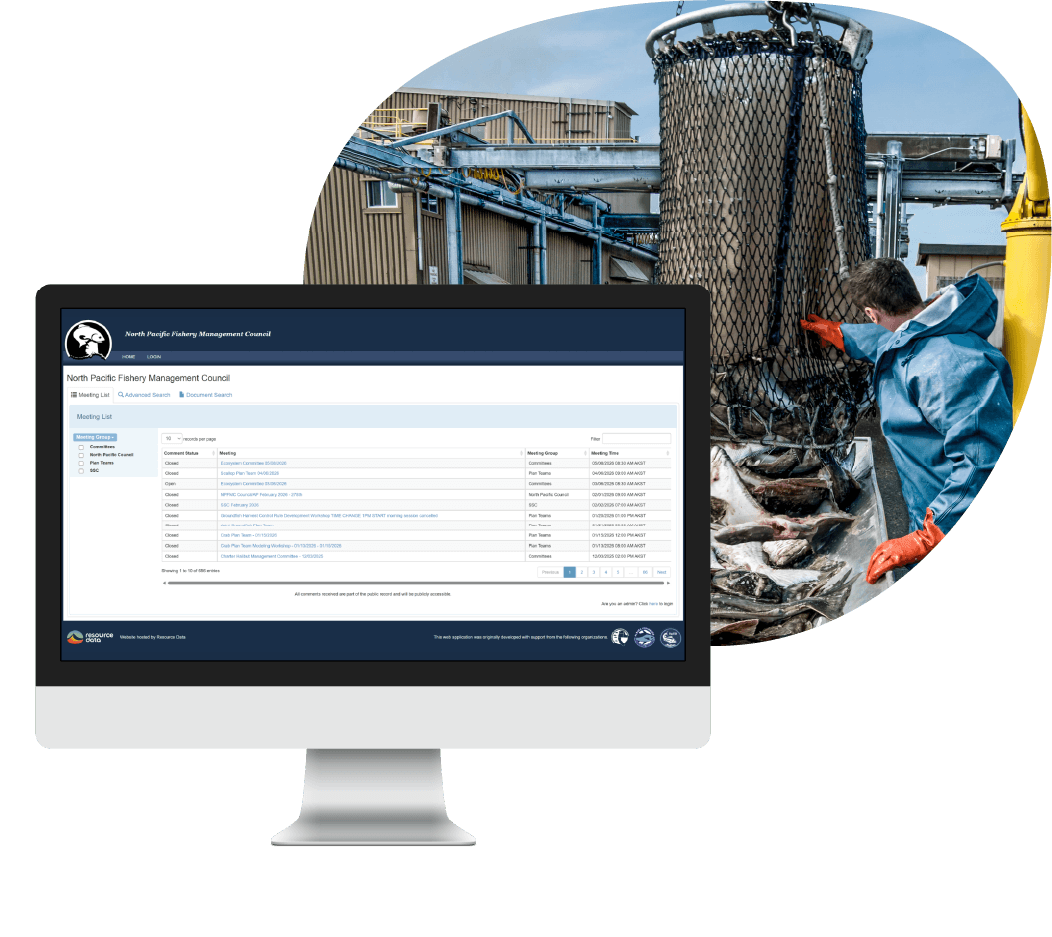
The North Pacific and Pacific Fisheries Management Councils oversee fisheries policy across Alaska and the US West Coast, running public meetings where testimony, scientific input, and council actions shape regulatory decisions. For years, staff collected comments through email, assembled meeting materials manually, and managed records across disconnected systems.
Resource Data, working with the Pacific States Marine Fisheries Commission (PSMFC), developed a web-based Agenda Management System that centralizes public comments, speaker sign-ups, agenda preparation, and document management. Since its initial launch in 2013, the platform has continued to evolve, improving reliability and adapting to changing needs.
Today, staff spend less time preparing materials, meetings run reliably, and decades of council records are searchable and accessible in one place.
Key Takeaways
Reliability, Automation, and Transparency
-
Automated public comment management reduces workload
Email-based comment collection and manual document assembly were replaced with a centralized workflow. Staff can collect, review, and organize public comments directly within the system.
-
Live meeting tools for managing public testimony
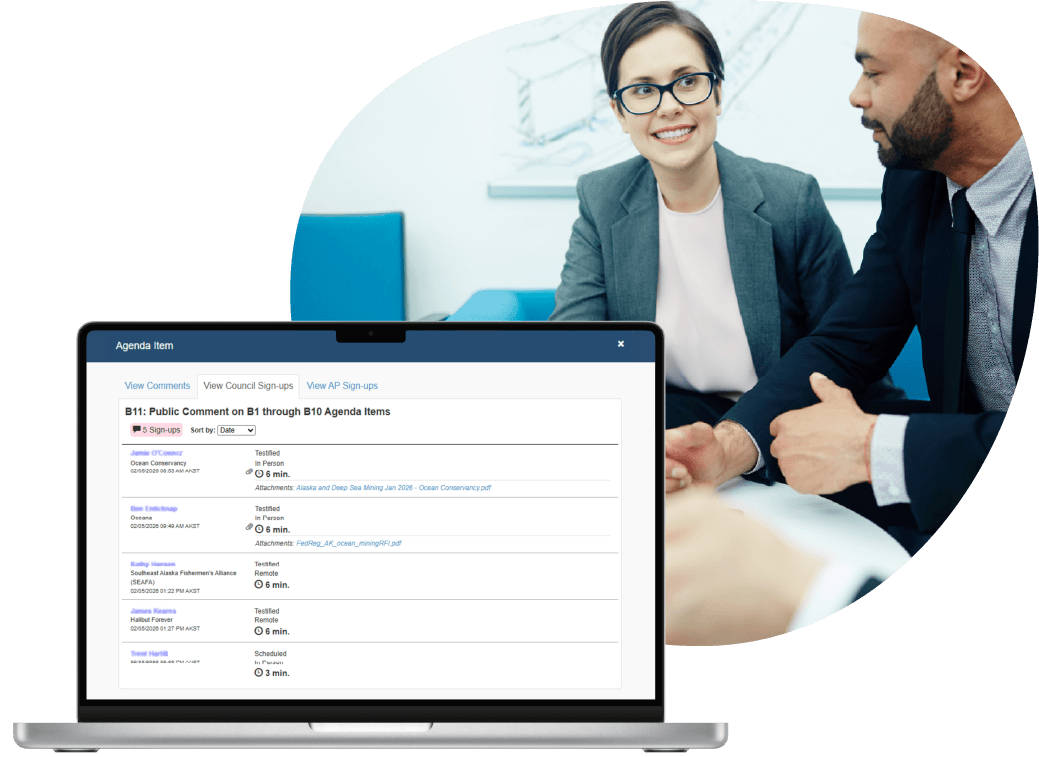
Participants can register to speak on agenda items through the application. During meetings, staff manage the speaker queue and display current and upcoming speakers.
-
Centralized archive of council records
Meeting materials, public comments, and supporting documents are stored in a single searchable archive covering decades of council activity.
-
Public access to meeting materials and records
Members of the public can submit comments, access meeting materials, and download council packages from a single location, improving transparency and access.
-
Shared platform supporting multiple organizations
The system’s multi-tenant architecture allows multiple agencies to operate within the same platform while maintaining separate data environments.

Meet Our Client
Pacific States Marine Fisheries Commission (PSMFC)
The Pacific States Marine Fisheries Commission (PSMFC) is an interstate compact agency that supports fisheries management across the U.S. West Coast and Alaska. The commission works closely with regional councils, including the North Pacific and Pacific Fisheries Management Councils, which were established under the Magnuson-Stevens Act, as well as state agencies to coordinate research, data collection, and regulatory processes.
Public council meetings are central to this work. During these meetings, agencies review policy proposals, receive public testimony, and document decisions that shape commercial, recreational, and subsistence fisheries. Because these decisions directly influence regional fisheries policy, the meeting process must remain organized, transparent, and well documented.

The Challenge
Manual meeting preparation under increasing participation demands
Public fisheries meetings require structured agendas, organized supporting documents, and a formal record of testimony and council decisions. For years, these responsibilities relied on manual processes. Public comments arrived through email, documents were stored across disconnected folders, and staff assembled meeting materials by hand before each session.
Preparing meeting packages required significant administrative effort and increased the risk of delays or errors. As participation expanded and more stakeholders joined meetings remotely, the systems supporting these sessions became indispensable for operations. When infrastructure problems occurred during live meetings, disruptions could halt testimony and create confusion for staff and participants.
The Solution
One system to run and document public fisheries meetings
Resource Data developed a web-based Agenda Management System that consolidates the tools required to prepare and run public fisheries meetings. The platform allows staff to create meeting agendas, collect and review public comments, manage speaker registrations, and organize supporting documents within one application. Submissions are tied to specific agenda items, allowing staff to prepare materials for council review more efficiently.
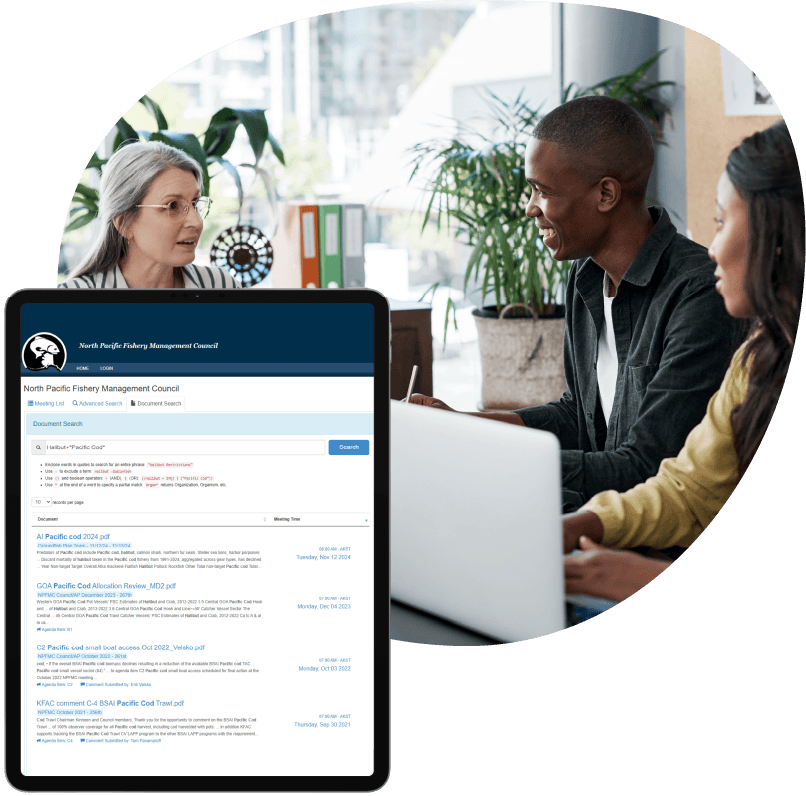
The system also serves as the long-term archive for council activity. Meeting materials, public comments, and attachments are indexed and searchable across decades of records. Because the application is used during both meeting preparation and live sessions, it functions not only as an administrative tool but also as part of the infrastructure supporting public decision-making.

Our Approach
Long-Term Collaboration and System Development
The Agenda Management System was first developed in 2013 to modernize how council meetings were organized and documented. As councils increasingly relied on the system, Resource Data expanded its capabilities. A searchable archive was created containing meeting records dating back to 1976. The platform was also adapted to support multiple organizations operating within a shared environment while maintaining separate data structures.
In 2025, the system was migrated to a dedicated Microsoft Azure environment to improve reliability during live meetings. This transition strengthened operational stability and ensured consistent performance during public sessions.
Features
Built around how councils run their meetings
-
Agenda Management for Meeting Preparation
Staff create and manage meeting agendas through a structured interface that links agenda items, attachments, and public comments. The system maintains a clear record of updates and revisions.
-
Public Comment Submission for Efficient Review
Members of the public submit comments through an online form associated with specific agenda items. Submissions are stored in the system and reviewed by staff before inclusion in official meeting materials.
-
Speaker Registration Real-Time Queue Visibility
Participants can register to provide testimony on agenda items. During meetings, staff manage the speaker queue and display speaker names and affiliations in real time. The system tracks participation as testimony is delivered.
-
Automated Meeting Packages for Consistent Materials
Staff can generate downloadable meeting packages that include agendas, attachments, and public comments. This ensures participants receive consistent materials.
-
Document Search for Fast Access to Records
Meeting materials and comments are indexed across decades of council activity. Full-text search allows staff to locate past decisions and supporting documents quickly.
-
Multi-Organization Architecture for Shared Agency Use
The system supports multiple organizations within the same platform while maintaining separation of meeting data and configurations for each group.
-
Azure Cloud Hosting for Reliable Live Performance
The application operates within a dedicated Microsoft Azure environment managed by Resource Data. This environment provides improved stability during live meetings and supports ongoing system expansion.


What started as a tool for collecting public comments has evolved into a platform that supports how these councils run their meetings.
- Rick Bush, Service Area Lead, Resource Data
Results
Meetings that are easier to manage and easier to access
Meeting preparation now runs through a structured system that organizes agendas, comments, and supporting materials in a single place. Staff work from a consistent source of information rather than assembling documents across multiple systems, and the workflow itself helps document the process for future meetings.
The platform also improves continuity for staff responsible for meeting coordination. Because meeting preparation happens within the system, new team members can more easily step into the role and maintain established processes.
For the public, participation follows a predictable process and meeting materials are available through a single point of access. Over time, the system has also strengthened the council’s institutional record by preserving decisions, testimony, and supporting documents in a searchable archive.

What's Next
Preparing for the next phase of public participation
As participation in public fisheries governance continues to grow, the Agenda Management System will continue evolving. Planned improvements include refinements to live meeting management tools and exploration of AI-assisted search capabilities to help staff and the public navigate decades of archived records more efficiently.
Because the platform operates in a cloud environment, these enhancements can be introduced without disrupting ongoing council operations while preserving the accessibility and integrity of the public record.




Case Study FAQ
A centralized agenda management platform is a digital system that helps public agencies create agendas, collect public comments, manage speaker registration, organize meeting documents, and preserve official records in one place.
For agencies that run formal public meetings, the platform becomes a shared operational infrastructure for agenda preparation, public participation, staff coordination, document management, and long-term recordkeeping. Instead of relying on email inboxes, disconnected folders, spreadsheets, and manual packet assembly, staff can manage the full meeting lifecycle through a structured workflow.
In the Resource Data fisheries modernization case study, Resource Data worked with the Pacific States Marine Fisheries Commission (PSMFC) to develop a web-based Agenda Management System for the North Pacific and Pacific Fishery Management Councils. The system centralized public comments, speaker sign-ups, agenda preparation, meeting materials, document search, and archives for public fisheries meetings.
This solution reduced administrative workload and process gaps. It also created better access to public materials and stronger continuity for staff. For public-sector organizations, that means meeting teams spend less time assembling materials manually and more time supporting transparent, well-documented decision-making.
Public meeting management software improves transparency by giving the public a clearer way to find agendas, submit comments, register to speak, access meeting materials, and review historical records.
Public participation is often tied to specific agenda items, deadlines, testimony procedures, and supporting documents. When those steps are split across email, PDFs, file folders, and separate web pages, participation becomes harder for the public and more difficult for staff to manage. A centralized platform improves access by connecting each public comment, attachment, agenda item, and meeting package to the right part of the public process.
In the Resource Data case study, members of the public can submit comments through an online form tied to specific agenda items and access meeting materials. They can also download council packages and participate in a more predictable process from a single location.
With this solution, agencies reduce the chance of misplaced comments, inconsistent materials, missed testimony logistics, and public confusion. At the same time, they improve trust by making the public record easier to access and easier to understand.
Workflow modernization is important because public boards, councils, and commissions often depend on repeatable, high-stakes processes that become inefficient and risky when managed manually.
Public meetings usually require structured agendas, official records, and public comments. It’s also important for them to have supporting documents, staff review, speaker coordination, and decision documentation. When those steps and items depend on manual handoffs, staff knowledge, and disconnected systems, agencies face higher risk of delays, errors, inconsistent records, and staff burnout. Modernizing the workflow creates a more reliable process that can be repeated across meetings, staff changes, and changing participation demands.
In the Resource Data case study, staff had been collecting public comments through email. They assembled meeting materials manually and managed records across disconnected systems. Resource Data’s centralized platform replaced those fragmented steps with structured agenda management, public comment intake, meeting package generation, speaker queue management, and searchable records.
With this solution, staff can prepare meetings more consistently, and new team members can step into established processes faster. Plus, agencies can handle greater public participation without adding proportional administrative burden.
Agencies can reduce manual work in public meeting preparation by replacing email-based intake, manual document assembly, and disconnected file storage with a centralized workflow. This workflow should organize agendas, comments, attachments, and meeting packages automatically.
The key is to design the system around how staff actually prepare and run meetings. That includes agenda-item creation, document uploads, comment review, speaker registration, package generation, revision tracking, and public access. When these steps are connected, staff do not have to copy information repeatedly between tools or rebuild materials before each meeting.
In the case study, staff can create and manage agendas through a structured interface and link agenda items to attachments and public comments. It also allows them to review submissions and generate downloadable meeting packages that include agendas, attachments, and public comments.
Though this case study does not state a specific dollar-savings figure, by reducing manual preparation time, this solution lowers administrative overhead, decreases rework, and helps these public agencies stretch staff capacity across recurring meetings.
A searchable archive is important because it turns historical meeting materials, public comments, testimony, and decisions into usable institutional knowledge instead of static records buried in folders or PDFs.
Public agencies need to answer questions about past decisions, policy history, scientific input, stakeholder comments, and procedural records. If there isn’t a simple way to search for documents and information, staff and the public may spend hours looking for prior materials or rely on institutional memory that can disappear when experienced employees leave. A searchable archive gives agencies faster access to evidence, precedent, and historical context.
In the Resource Data case study, meeting materials, public comments, and supporting documents are stored in a single searchable archive covering decades of council activity. Resource Data also created a searchable archive containing meeting records dating back to 1976, which helps staff locate past decisions and support documents more quickly.
Staff can retrieve prior materials more efficiently, and the public can access historical records more easily. Agencies also preserve institutional knowledge even as personnel, policies, and participation demand change.
A centralized public comment system reduces risk by tying each comment, attachment, review step, and agenda item to a structured record that staff can manage consistently.
Email-based comment collection creates problems for agencies because comments may arrive in different inboxes, formats, timeframes, and attachment types. Staff must organize submissions manually, match them to agenda items, prepare them for review, and preserve them as part of the public record. That creates operational, records, and public-trust risks.
In this case study, the Agenda Management System allows members of the public to submit comments through an online form associated with specific agenda items. Submissions are stored in the system and reviewed by staff before inclusion in official meeting materials.
With this system, agencies reduce the chance of losing comments, misclassifying materials, publishing inconsistent packets, or creating confusion during public review. A centralized comment workflow also supports better compliance posture because the agency has a more complete, organized record of participation.
Agencies modernizing legacy public-meeting workflows should consider the following:
– Process design
– System integration
– Accessibility
– Data governance
– Security
– Cloud reliability
– User adoption
– Long-term records management
The goal is not simply to digitize old paperwork. The stronger modernization approach is to redesign the workflow, so agendas, comments, documents, speakers, public access, and records work together as one process. This aligns with current government modernization research, which emphasizes redesigning operating models and workflows rather than treating modernization as a technology replacement.
In the Resource Data case study, the platform began as a tool for collecting public comments and evolved into a broader system for running and documenting public fisheries meetings. Resource Data expanded the platform over time to support searchable archives, multiple organizations, live meeting tools, and a dedicated Microsoft Azure environment.
The operational impact is scalability and lower implementation risk. Agencies can modernize around real workflows, phase in improvements over time, and avoid replacing one fragmented process with another. This is where Resource Data’s broader capabilities in custom software development, workflow modernization, system integration, data platforms, and cloud modernization are especially relevant.
Multi-organization architecture matters because it allows multiple agencies, councils, departments, or boards to use a shared platform while maintaining appropriate separation of data, workflows, and configurations.
Many public-sector organizations have similar meeting-management needs, but different procedures, records, committees, permissions, and public-facing materials. A shared platform can reduce duplication and support standardization, but it must also maintain organizational boundaries. Good architecture lets agencies share infrastructure without forcing every organization into the exact same process.
Resource Data’s centralized agenda platform supports multiple organizations within the same platform while maintaining separation of meeting data and configurations for each group. In this case study, it allowed multiple councils and organizations to operate in a shared environment without losing their distinct meeting structures and records.
Agencies can support more programs, councils, or boards without building separate systems for each one. This can reduce long-term technology to sprawl, simplify support, and create a stronger foundation for shared-service modernization.
AI-assisted search can help agencies use decades of public records more effectively by making it easier to find, summarize, and navigate historical meeting materials, comments, decisions, and supporting documents.
Traditional keyword search is useful, but it can struggle when users do not know the exact phrase, meeting date, agenda title, policy term, or document name they need. AI-assisted search can help staff and the public ask more natural questions across large archives, identify relevant records, and surface context from long histories of public decision-making. In 2026, AI is a top public-sector technology priority, with NASCIO reporting that artificial intelligence reached the top position in state CIO priorities for the first time.
In the Resource Data case study, planned improvements include exploring AI-assisted search capabilities to help staff and the public navigate decades of archived records more efficiently. Because the platform already centralizes and indexes decades of records, it has a stronger data foundation for future AI-assisted knowledge discovery than a scattered folder-based process would.
The results include faster research, better staff productivity, and improved public access. The risk-reduction caveat is also important; AI-assisted search for public records should be implemented with governance, source traceability, permissions, and human review so agencies can improve discovery without weakening trust in the public record.
The business case for replacing manual meeting processes with a custom digital platform is that agencies can reduce staff workload and improve process reliability. They can also lower records of risk, support public access, and scale participation without adding proportional administrative effort.
Manual meeting operations often hide costs in staff time, rework, document assembly, inbox management, meeting delays, records searches, and public support. These costs may not appear as a single software line item, but they affect productivity, service quality, staff continuity, and public trust. A custom platform can be worthwhile when the workflow is mission-critical, recurring, public-facing, and too specialized for generic tools.
In the Resource Data case study, staff moved from email-based comment collection, manual meeting-material preparation, and disconnected records management to a centralized Agenda Management System. The result was a structured process where staff spend less time preparing materials, meetings run more reliably, and decades of council records are searchable from one place.
In this example, results include avoiding cost, gaining efficiency, and reducing risk. For budget owners and procurement teams, the value is not only the software itself, but also the ability to make a recurring public process more predictable, auditable, accessible, and scalable over time.