
FishGen: Revolutionizing Fisheries Research in the Western US
In Brief
The Genetic Repository Streamlining Research and Conservation Efforts
In the fast-paced world of fisheries management, having timely access to accurate genetic data is crucial—but sharing this data across laboratories was a costly and complex challenge.
Then came FishGen. Built by Resource Data, in partnership with the Idaho Department of Fish and Game (IDFG), FishGen is the first-of-its-kind shared data repository for fish genetics research in the western United States. FishGen is a robust and versatile tool, saving participating labs time and money—and it’s ready for expansion to a wider breadth of projects and species.
Key Takeaways
Fostering collaboration, enhancing accuracy, and reducing costs with shared data.
-
FishGen: An Innovative, Shared Data Repository
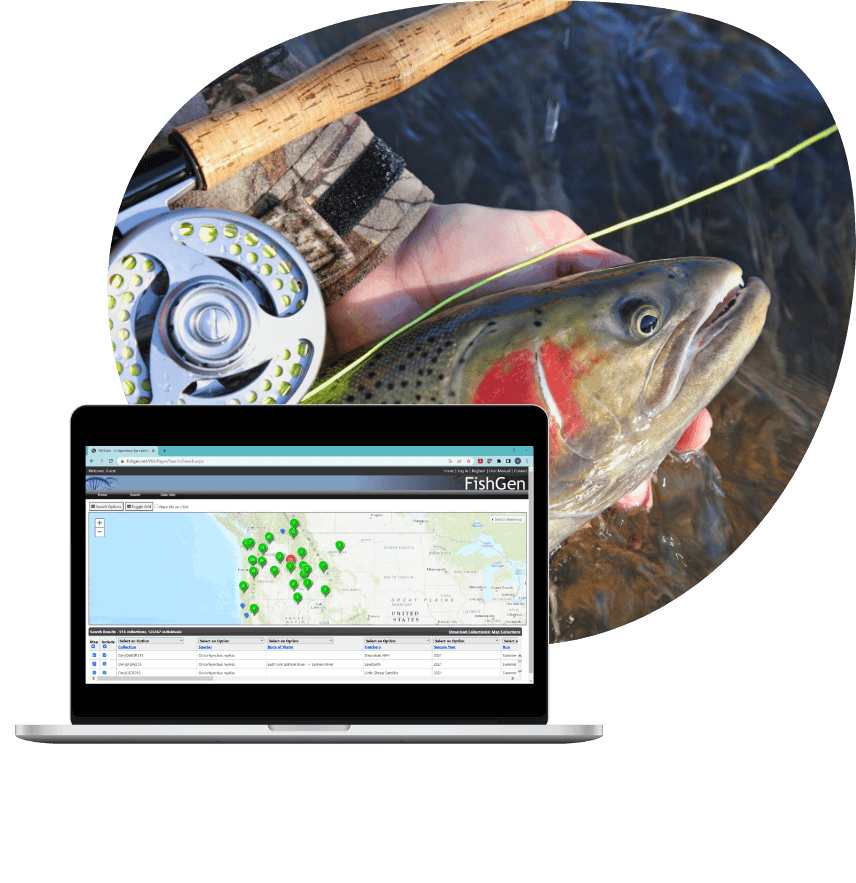
FishGen, a web-based software with GIS interface, is the western United States’ first shared fish genetics data repository.
-
Enhanced Reporting Quality and Collaboration
FishGen boosts collaboration between labs and reduces errors by eliminating the need for manual transfers of the substantial sample data collected annually.
-
Better Informed Research and Monitoring Programs
FishGen’s stored baselines are vital for research and monitoring programs in the Columbia River Basin. The data aids in developing effective population management strategies.
-
Future Potential: A Comprehensive Genetic Repository
With its potential to become a comprehensive genetic repository, FishGen aims to expand its scope to cover a wider range of projects and species in the Pacific Northwest.
The Challenges
Cumbersome & error-prone data sharing
Sharing genetic data among laboratories has traditionally been a cumbersome and error-prone process. Fisheries scientists in the Pacific Northwest and Alaska have diligently collected genetic information on fish species over the years. However, the exchange of this valuable data between labs has proven to be a challenging task, requiring substantial data transfers and incurring significant costs.
Although most fish genetics labs have their own databases to store and manage genetic data, these databases are not designed to serve as long-term, shared repositories. They lack web-based and GIS-enabled capabilities, making it difficult for multiple organizations to access and utilize the data effectively. The current method of sharing data relies on manual copying and pasting, inevitably leading to errors, especially when dealing with large amounts of data.
While there have been successful international, multi-laboratory projects, they have been limited in scope, often focusing on a single type of genetic marker and lacking proper marker validation procedures. Additionally, these projects did not incorporate GIS interfaces, further hindering collaboration.
The Solution
First shared, fish genetics data repository in the western United States
To address the challenges of merging regional data sets from multiple laboratories and enhance conservation and management efforts, the Idaho Department of Fish and Game, in collaboration with Resource Data, created FishGen.
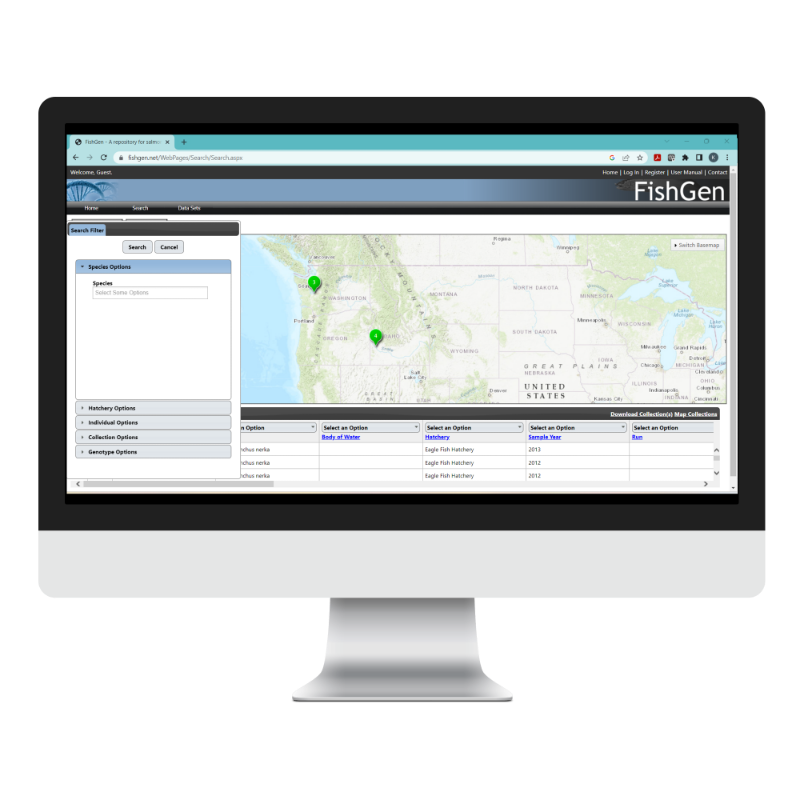
FishGen is a web-based, GIS-integrated software that serves as a dynamic and shared data repository for fish genetics data. Collaborating labs at agencies such as NOAA Fisheries and the Oregon Department of Fish and Wildlife can easily submit, search, and download genetic data, promoting collaboration and supporting monitoring projects.
The software, designed to handle tens of thousands of samples annually, was built with inputs from genetic laboratories for field requirements, validation, and marker standardization. The result is an industry-friendly interface and standardized protocols. Robust and versatile, FishGen was built to evolve and accept new types of genetic data, ensuring long-term accessibility and adaptability.
Features
Dynamic and evolving. Designed for long-term accessibility and security.
-
Save Data Set: Capture and share information easily
The “save data set” feature simplifies data sharing between laboratories and referencing data sets found in literature and publications.
-
User-friendly search: Find what you need quickly
Search results are displayed on a map or in a table with options to filter and refine further.
-
Easy Data Export: Fast reporting made simple
Export data in industry-standard formats for fast reporting to funding, fisheries management, and regulatory agencies.
-
Tailored Search Results: Customize your view
Choose from eight map base layers including satellite, topographic, USGS, and HUC.
-
Error Free Data Entry: Ensure accuracy effortlessly
Consistent input parameters and validation rules ensure uniform data entry and minimize errors such as uploading the same data under different names.
-
Nightly Backups: Protect your data
Redundant backups with Amazon S3 guarantee data preservation and archival.
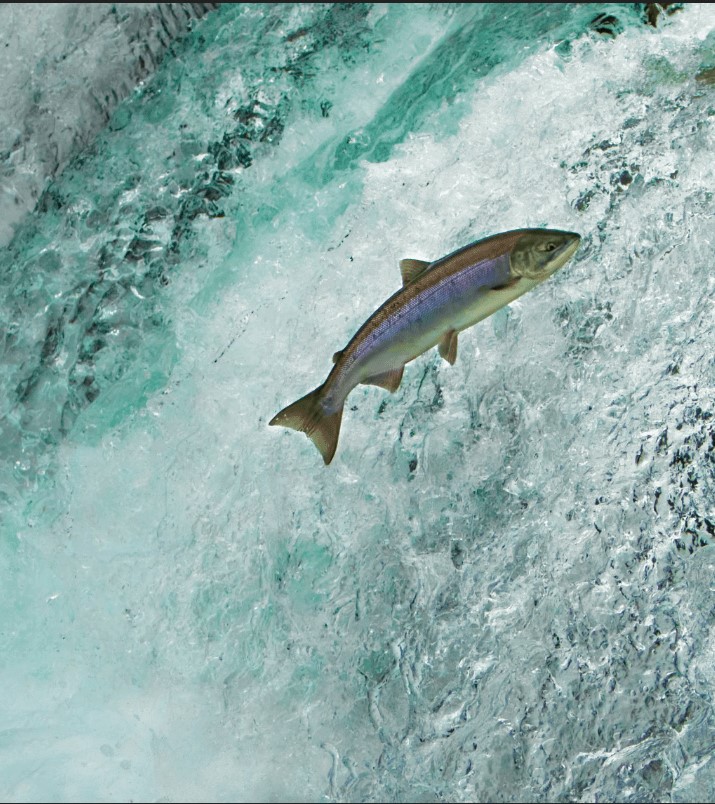
“[Fishgen is] an excellent tool for supporting genetic research and monitoring projects throughout the region.”
- Fisheries Magazine, Vol. 43, No. 7
Results
Unleashing Potential: FishGen’s Impact on Fish Conservation
FishGen is far more than just a data repository. It’s a platform for collaboration, bringing together laboratories from research institutes, universities, tribal, and government agencies in a way that wasn’t possible before in the Pacific Coast region. This easy access to baseline data is not just facilitating collaboration but also improving the management of commercial, recreational, and tribal harvest allocations.
The tool’s impact extends beyond its immediate users, contributing to research and monitoring programs across the Columbia River Basin and Pacific Coast of the United States and Canada. These programs play a vital role in developing strategies for population management.
With FishGen, we can now delineate mixed-stock fisheries more accurately, better assess the status of salmon and steelhead listed in the US Endangered Species Act, and gain a deeper understanding of population genetic structure. Furthermore, FishGen aids in estimating abundance, productivity, genetic diversity, and individual stock’s life history characteristics more accurately.
In essence, FishGen is unlocking new potentials in fish genetic research, paving the way for more informed decision-making and effective conservation strategies.
“[Resource Data was] an appealing choice for this project as they have experience working on many other fisheries-related projects.”
~ Jesse McCane, Data Coordinator
Idaho Dept. of Fish & Game's Eagle Fish Genetics Laboratory
What's Next
The Path Ahead: Expanding Horizons
The creation of FishGen marks a significant milestone in the sphere of fish genetics research and fisheries management in the western United States. This innovative tool has already proved its worth by saving participating laboratories both time and money. Its potential, however, is far from being fully tapped – with scope for expansion to accommodate a wider range of projects, species, and genetic marker types and subtypes in the future.
As FishGen continues to evolve and expand, there are high hopes that biologists, geneticists, and fisheries managers will see it as a one-stop genetic repository for Pacific Coast projects, recognizing its immense value as a tool for information sharing and collaboration across agencies.



Case Study FAQ
A shared genetics data repository can reduce costs by replacing repeated manual data transfers with a centralized system where participating laboratories can submit, search, download, and reuse validated genetic data. Instead of each lab maintaining separate data sharing processes, the repository becomes a common access point for baseline data, sample records, and reporting outputs.
In Resource Data’s project with the Idaho Department of Fish and Game, FishGen was built to support collaboration among labs that included agencies such as NOAA Fisheries and the Oregon Department of Fish and Wildlife. The system was designed to handle tens of thousands of samples annually and eliminate manual copying and pasting between disconnected databases.
Because of this work, labs spend less effort transferring, cleaning, and reconciling data. Also, fisheries managers gain faster access to information needed for research, monitoring, and population management decisions.
Better access to genetic data helps fisheries managers make more informed decisions about population health, harvest allocations, conservation priorities, and endangered species monitoring. When data is easier to find and trust, agencies can move from fragmented research records toward a more complete view of fish populations across regions.
Resource Data’s case study shows this in practice. FishGen gives laboratories and agencies a shared, GIS-integrated repository for fish genetics data across the Pacific Coast region, Columbia River Basin, and western United States. The case study connects this access to improved work around mixed stock fisheries, salmon and steelhead listed under the Endangered Species Act, abundance estimates, productivity, genetic diversity, and life history characteristics.
Agencies and researchers can use shared baseline data to support conservation strategies and reduce uncertainty. This solution also improves coordination across commercial, recreational, tribal, and regulatory contexts.
Agencies should look for a platform that supports long term access, data quality, security, scalability, and collaboration across organizations. A scientific data platform should store information and make the data easier to validate, search, share, export, and apply to real management decisions.
Resource Data’s FishGen case study demonstrates this kind of long term thinking. FishGen was built as a web based, GIS integrated repository with standardized input protocols, validation rules, industry standard exports, map and table search, configurable map layers, and nightly Amazon S3 backups. It was also designed to evolve over time and support new genetic data types, marker types, projects, and species.
Instead of funding a short lived database that solves only one narrow project need, agencies can invest in a platform that grows with scientific programs, protects data, and supports broader collaboration without proportional increases in manual administration.
Fisheries teams can reduce errors by replacing manual copying, pasting, and file based transfers with structured data entry, validation rules, standardized markers, and a shared repository. The goal is to make accurate data sharing part of the workflow instead of depending on repeated manual review.
In Resource Data’s case study, participating labs had collected valuable fish genetics data for years but sharing that data between separate laboratory databases was cumbersome, costly, and error prone. With FishGen, consistent input parameters, validation rules, and standardized protocols were created so labs could submit and access data more reliably.
The operational impact is improved reporting quality and reduced rework. When data is entered consistently and checked at the point of upload, teams are less likely to create duplicate records, use inconsistent names, or introduce errors during transfer. That gives researchers and fisheries managers more confidence in the data they use for monitoring, reporting, and conservation planning.
A practical workflow modernization project starts with the work teams are already doing, and then it replaces the most painful manual steps with a system that fits their data, users, and reporting needs. For fisheries research teams, that means supporting sample submission, search, mapping, download, validation, and export without forcing labs into a one size fits all process.
Resource Data’s FishGen case study shows this approach clearly. FishGen was built with input from genetic laboratories around field requirements, validation, and marker standardization. The resulting system includes a “save data set” feature, map and table search, filters, customizable map base layers, and export formats that support reporting to funding, fisheries management, and regulatory agencies.
Instead of creating technology that sits outside the day to day research workflow, Resource Data helped create a tool that supports how labs actually collect, share, and use fisheries’ genetics data.
GIS improves fisheries genetics repository by making location based data easier to understand, search, compare, and apply. For fisheries research, geography is not just a display feature; it is central to understanding populations, watersheds, basins, sampling locations, and management areas.
In this case study, FishGen includes a GIS interface that lets users view search results on a map or in a table, filter and refine results, and choose from eight map base layers (including satellite, topographic, USGS, and HUC layers). This helps researchers and managers work with genetic data in the geographic context where fisheries decisions are made.
Results include faster analysis and clearer communication. Teams can move from raw records to spatial understanding more quickly. This supports research, monitoring, harvest allocation, and conservation decisions. It also makes the system more useful to a broader group of users, not only database specialists.
A shared repository supports collaboration by giving different organizations a common place to contribute, find, validate, and reuse data. It reduces the friction that happens when each group stores information in its own database and relies on manual transfers to share it.
Resource Data’s case study describes FishGen as a platform that brings together laboratories from research institutes, universities, tribal organizations, and government agencies in a way that was not previously possible in the Pacific Coast region. Now, participating labs can submit, search, and download genetic data, while shared baselines support research and monitoring programs across the Columbia River Basin and Pacific Coast.
The operational impact is stronger in coordination without requiring every organization to abandon its own internal systems. FishGen creates a shared layer for collaboration, helping teams reduce duplicated effort, improve data consistency, and use regional genetic information more effectively.
A scalable scientific data repository needs structured data standards, validation rules, flexible search, secure backups, export options, and an architecture that can evolve as research needs change. Scalability involves handling more records, but it is also about supporting new projects, users, species, and data types without rebuilding the system from scratch.
Resource Data’s case study shows some of these features. FishGen was designed to handle tens of thousands of samples annually, support standardized marker protocols, and validate data entry. It also provides map and table search, exports data in industry standard formats, and preserves data through redundant nightly backups with Amazon S3. Plus, the system was built to accept new types of genetic data over time.
FishGen allows for scalability without proportional increases in staff effort or technology replacement costs. Agencies and labs can expand the repository’s use while maintaining data quality, accessibility, and long term preservation.
Validation is important because multiple laboratories may use different naming conventions, data structures, or submission habits. Those differences can create errors when data is combined. A multi laboratory genetics database needs rules that keep records consistent enough to be searched, compared, exported, and trusted.
In this case study, earlier multi lab projects were limited, partly because they lacked proper marker validation procedures. FishGen addressed this by incorporating field requirements, validation, marker standardization, consistent input parameters, and rules that help prevent problems such as uploading the same data under different names.
Validation helps protect the quality of shared genetic baselines, which are used for fisheries research, monitoring, population management, and conservation decisions. Cleaner data also reduces the time teams spend correcting errors later on.
A custom web application can modernize legacy scientific databases by creating a shared, web based access layer for the data workflows that need collaboration, search, mapping, validation, and reporting. Labs can continue managing internal systems while using the shared application for regional data exchange and long term access.
In Resource Data’s case study, most fish genetics labs already had their own databases, but those databases were not designed to be long term, shared, web based, GIS enabled repositories. FishGen filled that gap by giving collaborating labs a centralized platform to submit, search, download, map, and export genetic data.
Instead of forcing every participating lab through a full system replacement, Resource Data helped create a shared repository that improves collaboration, reporting, and data access while respecting the reality of existing laboratory systems.