




A Long-Term Partnership Strengthening Fisheries Management

In Brief
Modernizing Fisheries Management Through Technology
Faced with the challenge of managing vast and complex fisheries data across multiple states, the Pacific States Marine Fisheries Commission (PSMFC) has partnered with Resource Data since 2000 to implement transformative solutions. From developing advanced data warehouses to creating the first web-based system for electronic fish ticket reporting in the Western U.S., our work has strengthened PSMFC’s ability to fulfill its mission for more sustainable fisheries management.
Key Takeaways
24 Years of Partnership and Innovation
-
Advancing fisheries data management
Advanced digital solutions like eTix and ORCA continue to modernize PSMFC’s data collection, reporting, and sharing processes. These tools replace outdated, manual systems, ensuring faster, more accurate data reporting, improving efficiency across the fishing industry.
-
Building reliable, scalable data warehouses
By redesigning critical systems like PacFIN, AKFIN, and RecFIN, Resource Data has enabled PSMFC to efficiently consolidate, validate, and analyze vast amounts of fisheries data, providing actionable insights for sustainable fisheries management.
-
Empowering conservation through technology
Backed by modern data solutions, PSMFC coordinates research and monitoring activities, facilitates projects, and maintains central repositories on critical fishing industry data. With reliable data, PSMFC better supports policies and actions to conserve, develop and manage Pacific Ocean resources.
-
A long-term, trusted partnership
Over 24 years, Resource Data’s collaborative approach has evolved with PSMFC’s needs, supporting ongoing innovation, such as cloud migration and observer program advancements. This trusted partnership ensures PSMFC’s technology supports its mission.
Meet Our Client
Pacific States Marine Fisheries Commission (PSMFC)
Based in Portland, the Pacific States Marine Fisheries Commission (PSMFC) supports government resource agencies and the fishing industry in managing fishery resources sustainably across California, Oregon, Washington, Idaho, Alaska, and Hawaii.
With a mission to conserve, develop, and manage these resources, PSMFC coordinates research activities, monitors fishing operations, and oversees diverse projects. Their databases on fish and other marine species provide critical insights for fishery managers and the fishing industry.
Since 2000, PSMFC has partnered with Resource Data to collect, manage, and analyze vast amounts of fisheries data more accurately and efficiently.

Solutions
Innovating Fisheries Data Collection, Analysis, and Management
The following solutions highlight some of the major work we’ve done for PSMFC and how it’s helped them achieve their goals.
PacFIN
Nation's First Regional Fisheries Data Network
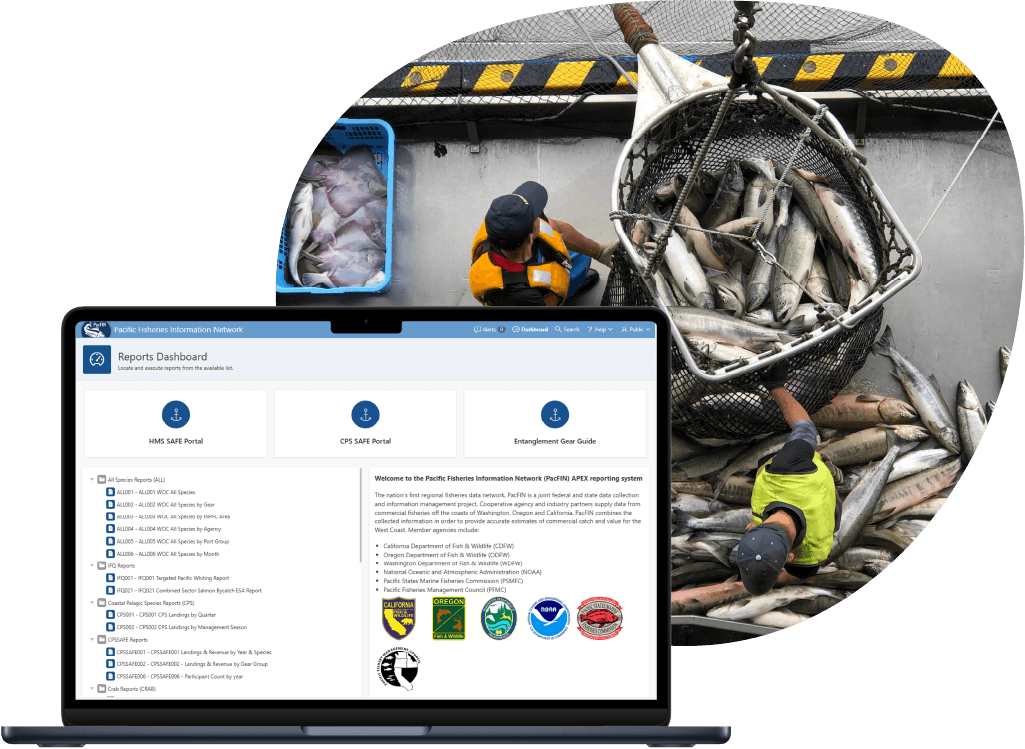
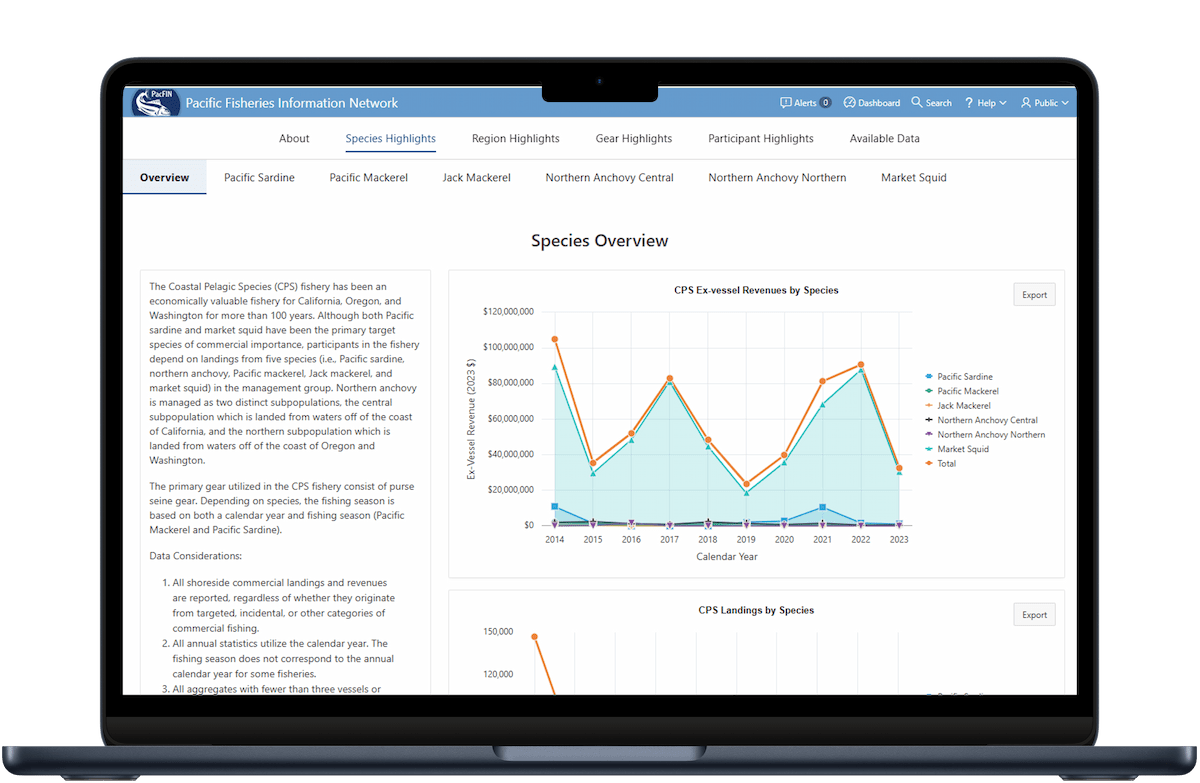
Pacific Fisheries Information Network (PacFIN), the nation’s first regional fisheries data network, aggregates and analyzes commercial fishery data to support management of West Coast fisheries. This data is critical for fishery managers, state agencies, and the Pacific Fishery Management Council to track catches and respond to increasing demands on fishery resources.
Resource Data completely redesigned the PacFIN data warehouse, conducting an in-depth analysis of user reporting needs and designing a new architecture, including updated schemas, data flows, and models. We managed the migration and audit of over 30 years of historical data and developed a web portal for state agencies to submit data easily.
Since the redesign, we’ve continued to maintain and enhance the system, adding analytical tools to meet evolving requirements. The modernized warehouse and portal have significantly improved the accuracy and accessibility of data, resulting in better fisheries management along the West Coast.
RecFIN
Uniting State and Federal Fishery Management Efforts
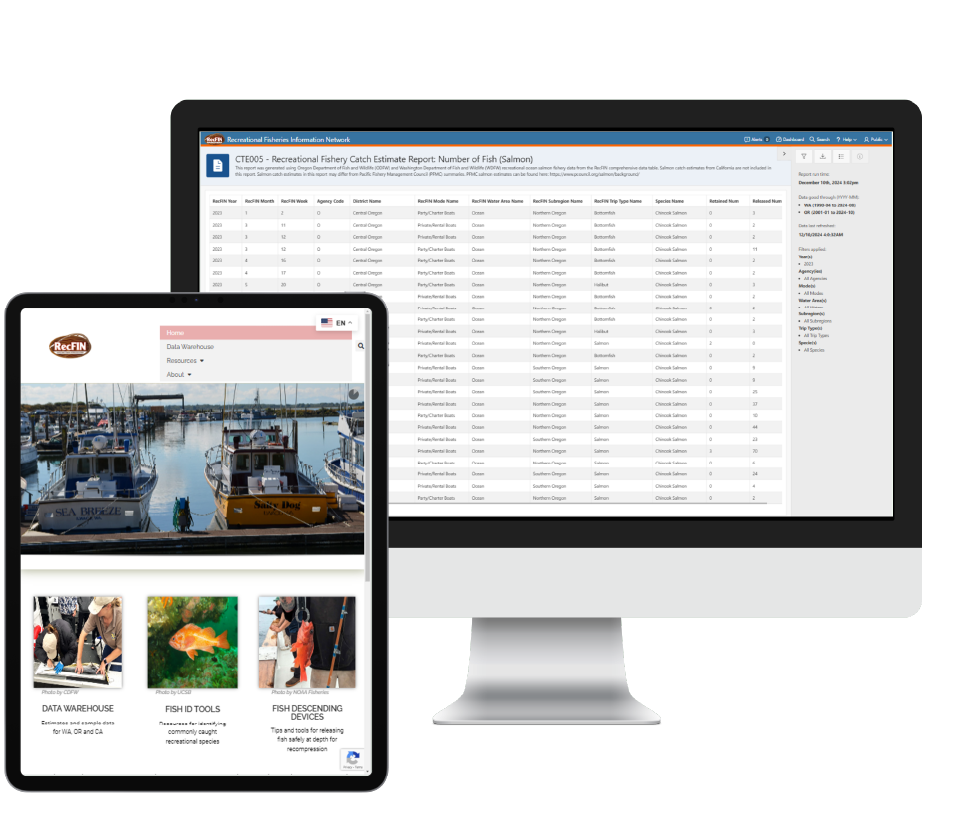
Recreational Fisheries Information Network (RecFIN) unites state and federal efforts to monitor recreational fishing harvests, effort, and distribution. This integrated approach provides essential data for fisheries management and stock assessment needs.
Resource Data modernized RecFIN’s outdated data storage system, creating a robust data warehouse to meet contemporary organizational standards. We designed and implemented a new database, migrated existing data, and developed standardized ETL processes for enhanced integration of data from multiple sources. Our team also introduced comprehensive data marts to make that data available to analysts.
The upgraded system enhances RecFIN’s ability to collect, analyze, and report on recreational fisheries data, ensuring better support for management and conservation initiatives.
E-Tix
First Web-Based Fish Ticket Reporting System in the Region
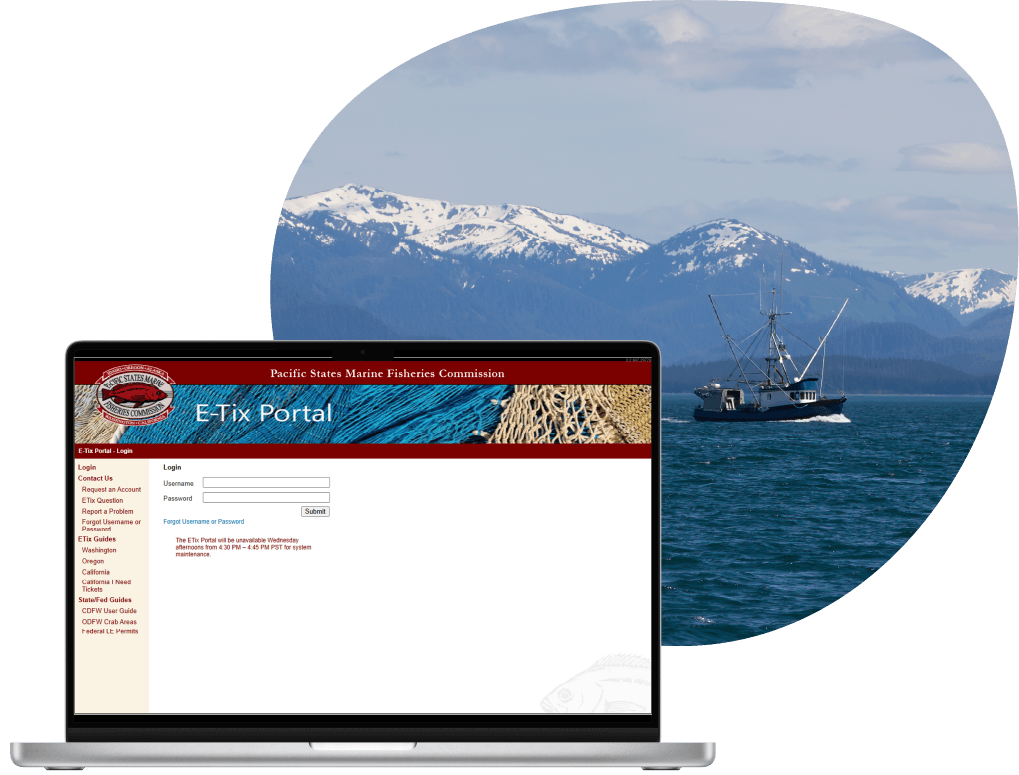
PSMFC needed a modern solution to replace disparate, error-prone systems for reporting fish ticket data along the West Coast. Resource Data developed E-Tix, the first web-based system for electronic fish ticket reporting in the region, enabling fish dealers in Oregon, Washington, and California to submit data online easily.
Our team redesigned the legacy systems, building a unified web portal and database to capture and report fish ticket data efficiently. Since its launch, Resource Data has provided ongoing support and enhancements, including updates for regulation changes and feature improvements based on PSMFC’s needs.
E-Tix has transformed fisheries data reporting, creating a reliable, accessible platform for managing submissions. By improving processes and reducing errors, the system supports PSMFC’s mission to improve fisheries management across the Western United States.
Economic Data Reporting
Reliable Reporting for Better Regulation
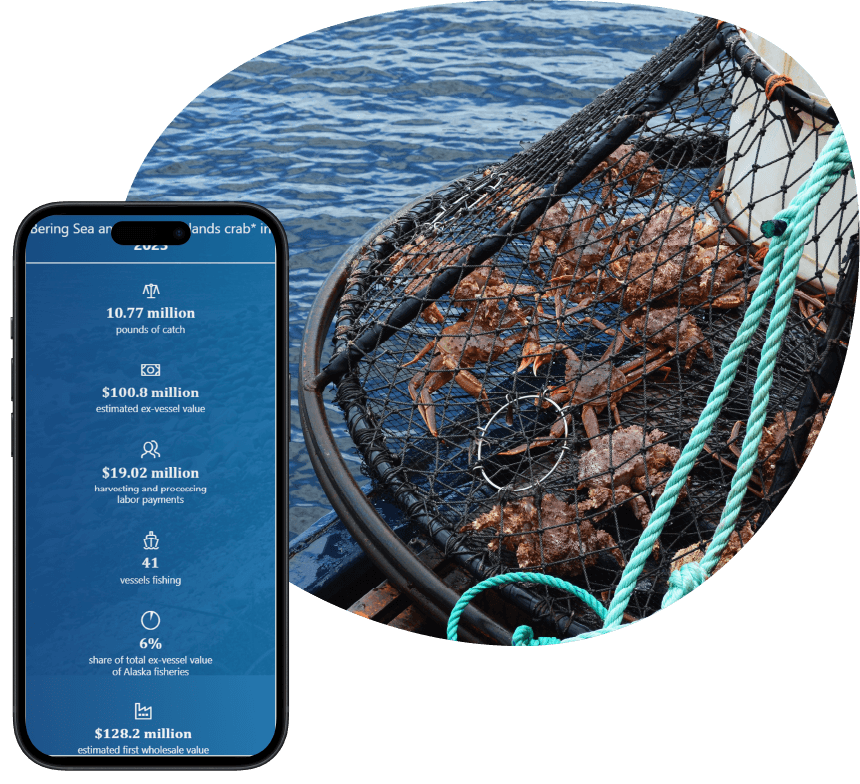
PSMFC oversees Economic Data Reporting (EDR) collections to analyze the economic effects of fisheries programs. These reports provide regulators with critical data on costs, revenues, ownership, and employment, informing program assessments and changes.
Since 2009, Resource Data has supported the EDR database with programming and maintenance to ensure reliable data storage and reporting. Our work includes developing tailored data collection solutions, such as fillable PDFs, Oracle (APEX) applications, and .NET XML forms—and adapting them to meet evolving needs and new program amendments.
By enabling efficient data collection and analysis, our solutions help PSMFC and regulators better understand program impacts on harvesters, processors, and communities. The result is more data-driven and cost-effective fisheries management across the region.
AKFIN
Consolidating Commercial Fishing Data
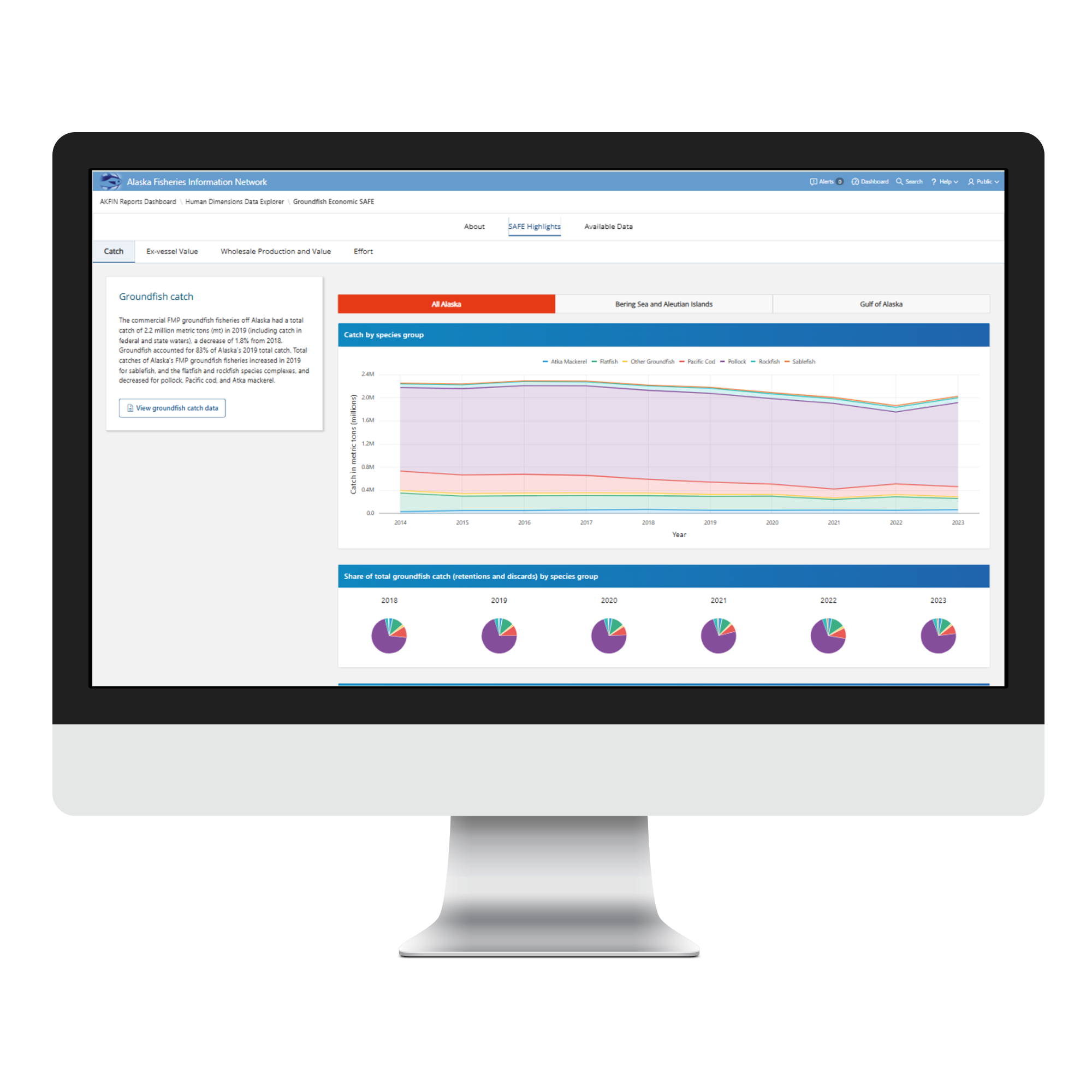
Alaska Fisheries Information Network (AKFIN) consolidates essential commercial fisheries data for North Pacific and Alaskan fisheries, enabling economists and scientists to assess the impacts of management decisions on individuals and communities.
Our team has played a key role in designing and developing AKFIN’s data warehouse, incorporating advanced ETL, data validation, and custom database structures for precise reporting. We collaborated with the AKFIN team to develop datamarts and evolve the system from raw data queries to a dimensional warehouse with a business intelligence repository and end-user query tools. These efforts have improved AKFIN’s ability to deliver actionable insights, strengthening fisheries management and sustainability in our northernmost fisheries.
ORCA
An App for Easy At-Sea Data Collection
On a boat in the rolling Pacific, obtaining clear and complete data with just pencils and paper poses a significant challenge. Despite this, NOAA Fisheries-trained observers on fishing vessels were successfully gathering essential scientific data using these traditional methods—but it was time consuming and difficult.
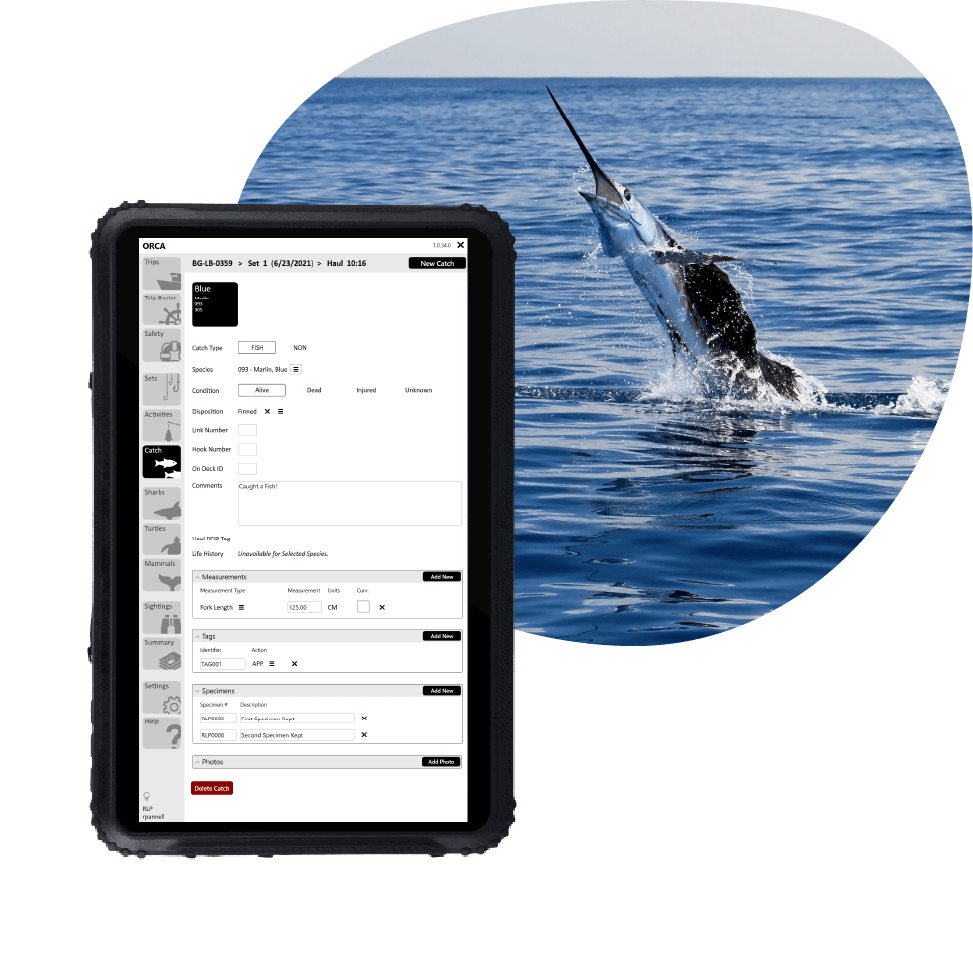
The West Coast Region Observer Program and Resource Data revolutionized marine data collection through the development of the Onboard Record Collection App (ORCA), a tablet-based application designed specifically to withstand temperamental at-sea conditions. Information integral to ensuring the sustainability of fisheries is now gathered more efficiently, significantly saving time and improving data quality for precise reporting.
Based on ORCA’s success, for deep set buoy gear, PSMFC and Resource Data recently partnered to develop a new version of ORCA for longline fishery Observer Programs for both the National Marine Fisheries Service’s (NMFS) Pacific Island Regional Office (PIRO) and West Coast Regional Office (WCRO).
Results
Improving processes to sustain fisheries
Through our partnership, PSMFC has modernized operations to better fulfill its mission of supporting sustainable fisheries. By transitioning from paper to electronic processes, our solutions have enabled faster, more accurate data reporting from ships, fishing processors, and other stakeholders. Projects like E-Tix have replaced decades of manual reporting, ensuring data quality and compliance across state and federal agencies.
Our data warehouse work has reinforced PSMFC’s role as a central repository of fisheries data, giving decision-makers the insights needed to assess policies. Their observer programs also benefit from the staffing we’ve provided and at-sea reporting tools we’ve built.
As PSMFC’s trusted partner in database development, IT strategy, and more, we’ve helped them stay ahead of technological trends. This has empowered PSMFC’s staff and clients to tackle critical initiatives.
“The more you can shorten the path between the data entry method and the database, the less likely you are to end up with inaccurate or bad data. You cut out those quality control slips. Observers can now spend more time on biological sampling and not worry about data forms getting soaked or blown away. It’s so much easier and efficient.”
- Jody Van Niekerk, ORCA Project co-lead & Biologist, NOAA Fisheries West Coast Region

What's Next
New and Familiar Horizons
Our ongoing partnership with PSMFC is focused on advancing their technological capabilities. A key initiative involves migrating their Oracle-based, on-premises data warehouses to a high-performance cloud platform, enhancing efficiency while maintaining compatibility with their existing systems.
Hawaii recently joined PSMFC, and we are uniquely positioned to modernize their fisheries management and data collection systems, bringing them in line with the advanced infrastructure used across the West Coast. This progress will strengthen the unified mission of the Pacific states.




Case Study FAQ
A fisheries commission can modernize complex data collection by treating each program as part of a shared data ecosystem rather than a separate software problem. Commercial fishery data, recreational harvest data, economic reporting, fish ticket submissions, and at-sea observer records each have different workflows, but they all need reliable collection, validation, reporting, and access models.
In Resource Data’s case study, the Pacific States Marine Fisheries Commission (PSMFC) worked with Resource Data across multiple major systems, including PacFIN, RecFIN, E-Tix, Economic Data Reporting, AKFIN, and ORCA. Each system addressed a distinct fisheries management need, but together they strengthened how PSMFC collects, manages, analyzes, and shares fisheries data across California, Oregon, Washington, Idaho, and Alaska.
In this case study, fisheries modernization works best when technology decisions support the full operating environment. That leads to better data quality, faster reporting, less duplication, and stronger decision support for agencies, fishery managers, scientists, economists, observers, and industry stakeholders.
A fisheries organization may need a long-term technology partner because fisheries data systems evolve with regulations, programs, reporting requirements, scientific needs, and technology standards. One-time software delivery may solve an immediate problem; however, it often leaves agencies struggling to maintain, adapt, and integrate systems as requirements change.
PSMFC has partnered with Resource Data since 2000. Over more than 25 years, Resource Data has supported major fisheries systems including PacFIN, RecFIN, E-Tix, EDR, AKFIN, and ORCA, and helped PSMFC prepare for future work such as migrating Oracle-based, on-premises data warehouses to a high-performance cloud platform.
This case study shows the value of continuity in complex public-sector and natural resource technology environments. There is reduced implementation risk, stronger institutional knowledge, and better long-term maintainability. A partner that understands the mission, data, users, and regulatory context can help systems evolve without forcing each project to start from scratch.
Better fisheries data infrastructure helps agencies make more defensible decisions by improving the accuracy, accessibility, timeliness, and consistency of the data behind policy and resource management. When fisheries data is fragmented, delayed, or difficult to validate, managers have less confidence in the information used to assess catches, economic effects, recreational harvests, stock conditions, and regulatory impacts.
PSMFC supports government resource agencies and the fishing industry by maintaining central repositories on critical fishing industry data. Resource Data’s work strengthened the systems PSMFC uses to collect, validate, analyze, and report commercial, recreational, economic, and observer data.
This Resource Data case study demonstrates that data modernization is tied directly to conservation and management outcomes. Reliable data gives managers and regulators a clearer foundation for policies affecting harvesters, processors, coastal communities, agencies, and marine resources.
Redesigning a fisheries data warehouse can improve reporting by updating the architecture, schemas, data flows, and data models that determine how information is collected, stored, validated, and accessed. For fisheries programs, these improvements matter because managers and agencies may rely on decades of historical data and ongoing submissions from multiple jurisdictions.
In Resource Data’s case study, Resource Data completely redesigned the PacFIN data warehouse, the nation’s first regional fisheries data network. The work included an in-depth analysis of user reporting needs, a new architecture, updated schemas, data flows, and models, the migration and audit of more than 30 years of historical data, and a web portal for state agencies to submit data more easily.
This example shows that a data warehouse redesign is not only a technical upgrade. Benefits include improved accuracy, better data accessibility, and stronger support for fishery managers, state agencies, and the Pacific Fishery Management Council as they track catches and respond to increasing demands on West Coast fishery resources.
Integrating recreational fisheries data from state and federal sources requires standardized data structures, reliable ETL processes, a modern data warehouse, and analyst-ready data marts. Recreational fisheries data can come from different programs, collection methods, and jurisdictions, so integration depends on technical design and a clear understanding of how managers use the information.
In Resource Data’s case study, RecFIN unites state and federal efforts to monitor recreational fishing harvests, effort, and distribution. Resource Data modernized RecFIN’s outdated data storage system by creating a robust data warehouse, designing and implementing a new database, migrating existing data, developing standardized ETL processes, and introducing comprehensive data marts for analysts.
This example illustrates that integration is most valuable when it makes data easier to use, not just easier to store. That can lead to faster analysis, more consistent reporting, and better support for fisheries management and stock assessment needs.
ETL, data validation, and custom database structures improve fisheries reporting by making large, complex datasets more accurate, traceable, and useful for analysis. In North Pacific and Alaska fisheries, data should support economists, scientists, managers, and communities trying to understand the effects of management decisions.
In Resource Data’s case study, AKFIN consolidates essential commercial fisheries data for North Pacific and Alaskan fisheries. Resource Data helped design and developed AKFIN’s data warehouse using advanced ETL, data validation, and custom database structures for precise reporting. The team also collaborated with AKFIN to develop datamarts and evolve the system from raw data queries to a dimensional warehouse with a business intelligence repository and end-user query tools.
This example shows how mature data engineering improves technical performance and decision support.
Electronic fish ticket reporting can reduce errors by replacing fragmented and manual reporting processes with a unified online system that sends submitted data more directly into the database. The shorter and more consistent with the path from data entry to storage, the fewer opportunities there are for transcription mistakes, delayed reporting, lost paperwork, or inconsistent formats.
In Resource Data’s case study, PSMFC needed to replace disparate, error-prone fish ticket reporting systems along the West Coast. Resource Data developed E-Tix, the first web-based electronic fish ticket reporting system in the region. It helped fish dealers in Oregon, Washington, and California submit fish ticket data online through a unified web portal and database.
This case study demonstrates that electronic reporting improves efficiency and data quality. Some of its benefits are faster submissions, fewer errors, stronger compliance support, and more reliable information for fisheries managers. By continuing to enhance E-Tix for regulation changes and feature improvements, Resource Data also helped the system remain useful as reporting needs evolved.
A tablet-based observer app can improve data quality by replacing difficult paper-based field workflows with a tool designed for real at-sea conditions. Observers working on fishing vessels need to collect scientific data accurately while dealing with motion, weather, water exposure, limited space, and time-sensitive biological sampling responsibilities.
In Resource Data’s case study, the West Coast Region Observer Program and Resource Data developed the Onboard Record Collection App (ORCA). ORCA was designed for temperamental at-sea conditions where paper forms could get wet, damaged, or difficult to manage. The case study notes that ORCA saves time and improves data quality for precise reporting.
This Resource Data example shows that field applications must fit the environment where the work actually happens. They can improve operations with less time spent managing forms, more time available for biological sampling, and better data quality for sustainable fisheries reporting. ORCA’s success also supported new versions for longline fishery observer programs for NMFS Pacific Island and West Coast regional offices.
Shortening the path between fisheries’ data entry and the database improves reporting accuracy because it reduces the number of handoffs, re-entry steps, and quality control gaps where errors can occur. The closer the data capture method is to the final database, the less likely information will be lost, misread, delayed, or changed unintentionally.
In Resource Data’s case study, this principle appears across multiple systems. E-Tix allows fish dealers to submit fish ticket data online. ORCA helps observers collect at-sea data electronically rather than relying on paper forms. PacFIN and RecFIN modernization improved data submission, integration, and reporting workflows.
This case study shows that data quality is partly a workflow design problem. For fisheries management, the improvements from Resource Data’s work matter because decisions about harvests, conservation, economic impacts, and policy depend on trustworthy data.
Fisheries’ economic reporting systems help regulators understand program impacts by collecting and organizing data on costs, revenues, ownership, employment, and related economic factors. With these details, regulators assess how fisheries programs affect the people, businesses, and communities connected to the industry.
In Resource Data’s case study, PSMFC oversees Economic Data Reporting (EDR) collections to analyze the economic effects of fisheries programs. Since 2009, Resource Data has supported the EDR database with programming and maintenance, including tailored data collection solutions such as fillable PDFs, Oracle APEX applications, and .NET XML forms. Resource Data also adapted those tools to meet evolving needs and new program amendments.
This example shows that economic reporting modernization supports more data-driven regulation. There is better visibility into program effects, more reliable data storage and reporting, and more cost-effective fisheries management across the region.
Fisheries organizations should consider system compatibility, reporting continuity, performance, data quality, user access, migration risk, and long-term maintainability before moving on-premises data warehouses to the cloud. The goal should be to modernize infrastructure without disrupting the systems that agencies, analysts, managers, and program teams rely on.
In Resource Data’s case study, PSMFC and Resource Data are focused on migrating Oracle-based, on-premises data warehouses to a high-performance cloud platform while maintaining compatibility with existing systems. That compatibility requirement is important because PSMFC’s data warehouses support critical fisheries management workflows for different programs and jurisdictions.
As this case study shows, cloud migration leads to better efficiency, improved scalability, and a stronger foundation for future modernization. When done carefully, cloud modernization can reduce infrastructure constraints while preserving the trust and continuity needed for mission-critical fisheries data systems.
Fisheries’ technology modernization can support a new state or region by bringing its data collection and management systems into alignment with established infrastructure, reporting standards, and analytical workflows. This is important when a new participant joins a broader regional mission and needs to coordinate with existing state, federal, and commission-level systems.
In Resource Data’s case study, Hawaii recently joined PSMFC. The next phase of work is modernizing Hawaii’s fisheries management and data collection systems to bring them in line with the advanced infrastructure used across the West Coast. Resource Data’s long-term work with PacFIN, RecFIN, E-Tix, AKFIN, EDR, and ORCA gives the partnership a strong foundation for this kind of regional expansion.
This example shows that modernization can improve consistency across jurisdictions and preserve program-specific needs. As a result, there is stronger coordination, more comparable data, and better support for the unified mission of Pacific states working to conserve, develop, and manage fisheries resources.